
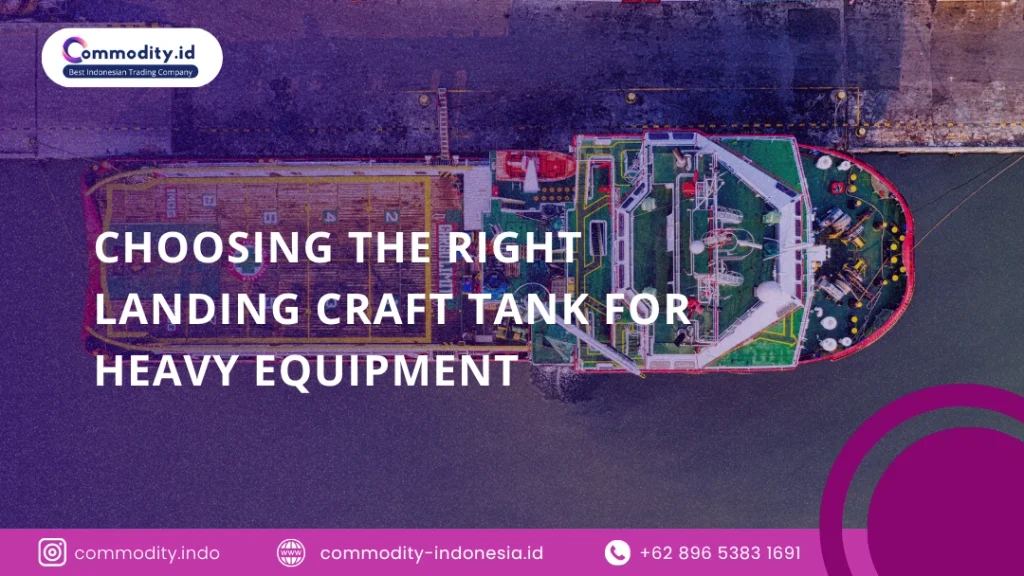
LCT transportation for heavy equipment and project cargo requires more than simply checking how many tonnes a vessel can carry. When selecting a Landing Craft Tank for a project, many companies begin with one question:
“How many tonnes can the vessel carry?”
It is an important question. However, it is not the only factor that matters.
For heavy equipment and project cargo, deck space can be just as important as deadweight capacity, or DWT. In addition, cargo dimensions and loading configuration can significantly affect the suitability of a vessel.
An LCT may theoretically have enough carrying capacity for the total weight of the cargo. Nevertheless, the vessel may still be unable to accommodate the equipment safely because of its dimensions and required deck arrangement.
View more about Landing Craft Tank
Why DWT Alone Is Not Enough for LCT Transportation
Consider two shipments, each weighing approximately 400 tonnes.
The first shipment may consist of compact industrial materials that can be efficiently arranged on the deck. In contrast, the second shipment may include several excavators, dump trucks, and long construction equipment.
Although the total cargo weight is the same, the second shipment may require considerably more deck area. As a result, these two shipments may require completely different LCT configurations.
Therefore, selecting an LCT based only on total tonnage can result in an inefficient or unsuitable vessel configuration.
For heavy equipment transportation, the available deck dimensions and loading arrangement should be evaluated together with the cargo weight.
Key Factors in LCT Transportation
1. Cargo Weight
The total cargo weight remains one of the most important considerations.
The vessel must have sufficient capacity for the planned cargo. At the same time, the loading arrangement must remain within the vessel’s operational and safety requirements.
2. Cargo Dimensions
Length, width, and height can be just as important as weight.
For example, a 50-tonne excavator may require significantly more deck space than 50 tonnes of compact industrial materials.
Therefore, equipment dimensions should be provided before selecting the vessel.
3. Available Deck Space
Deck space determines whether multiple units of equipment can be positioned safely and efficiently.
Furthermore, this becomes particularly important when transporting a combination of excavators, bulldozers, dump trucks, cranes, vehicles, and other project cargo.
4. Ramp Capacity and Loading Requirements
Because LCT vessels are commonly used for vehicles and heavy equipment, loading arrangements also need to be considered.
For instance, the type of equipment, its dimensions, wheel or track configuration, and loading location can influence the required ramp arrangement and operational planning.
5. Draft and Route
The vessel must also be suitable for the planned route and destination.
In addition, water depth, port or landing conditions, tidal conditions, loading location, and destination access can influence which LCT configuration is appropriate.
A vessel that appears suitable based on DWT may not necessarily be suitable for a particular destination. Consequently, route conditions should always be evaluated together with vessel specifications.
Safe Cargo Arrangement During LCT Transportation
Selecting the right vessel is not simply a matter of finding an LCT with a large enough capacity.
However, cargo must also be properly positioned and secured for the voyage.
The International Maritime Organization, through its Code of Safe Practice for Cargo Stowage and Securing, emphasizes the importance of proper cargo stowage and securing to reduce risks during maritime transportation.
For this reason, cargo planning should consider not only how much cargo can be carried, but also how the cargo will be arranged, positioned, and secured on deck.
A Better Question to Ask
Instead of asking:
“What size LCT do I need for 500 tonnes?”
A better question is:
“What LCT can safely accommodate the weight, dimensions, loading configuration, route, and destination of my cargo?”
Ultimately, this small change in perspective can lead to significantly better logistics planning.
Therefore, the right LCT should be selected based on the complete cargo profile, rather than DWT alone.
View more about Commodity Indonesia
What Information Is Needed for LCT Transportation?
Before arranging an LCT, prepare as much cargo information as possible, including:
- Cargo type
- Quantity
- Total weight
- Individual unit weight
- Length
- Width
- Height
- Loading location
- Destination
- Required loading date
- Special handling requirements
In addition, providing complete cargo information makes it easier to evaluate the appropriate vessel configuration.
Planning Heavy Equipment Transportation in Indonesia?
Commodity Indonesia supports LCT transportation for heavy equipment, construction materials, commodities, industrial machinery, and project cargo across Indonesia.
Our Landing Craft Tank service supports various cargo requirements, including excavators, bulldozers, wheel loaders, dump trucks, cranes, industrial machinery, construction materials, and project cargo.
Furthermore, for larger bulk and marine transportation requirements, you can also explore our Barge Chartering service.
To evaluate the appropriate LCT for your project, start by sharing:
Cargo Type • Quantity • Weight • Dimensions • Origin • Destination • Required Schedule
Finally, the appropriate LCT configuration and transportation requirements can be evaluated based on the actual cargo and route.
In conclusion, the right LCT is not simply the vessel with the highest DWT. Instead, it is the vessel that fits the cargo, the route, and the operational requirements of the project.